The Quiet Burnout: When You’re Functioning… And Still Not Okay
May 03, 2026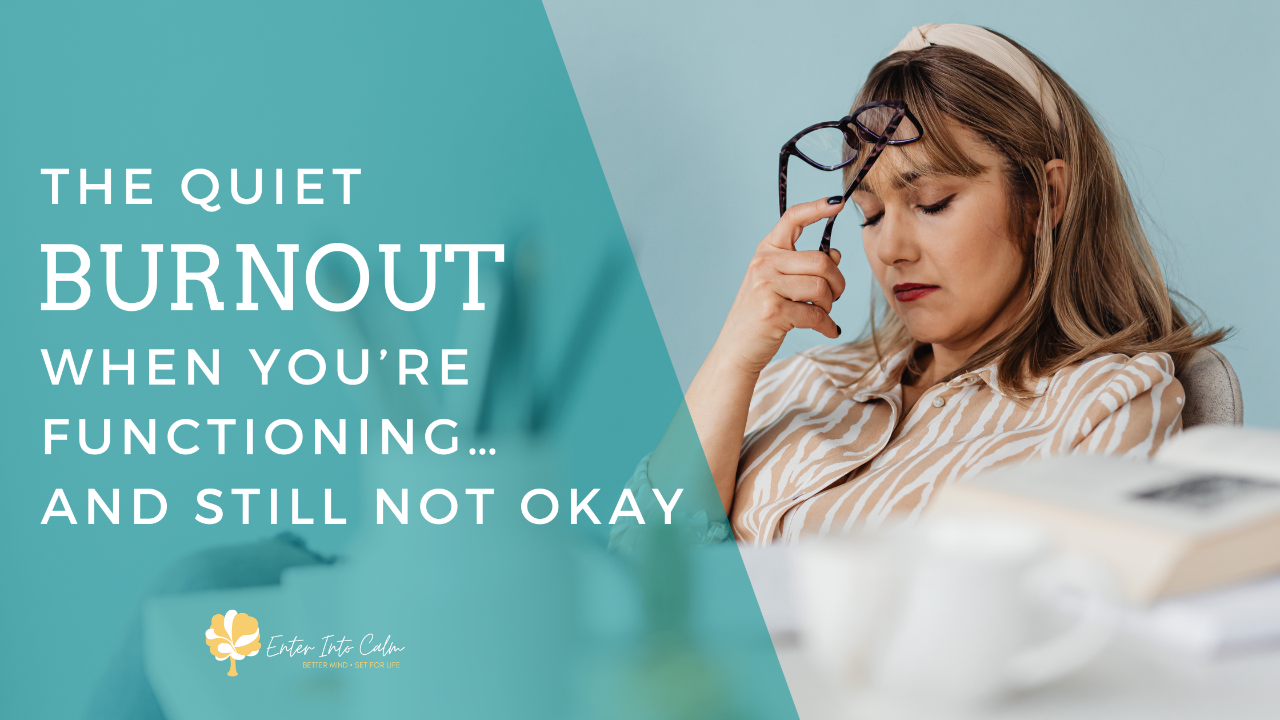
There’s a version of burnout that doesn’t always look like burnout.
You’re still showing up.
Still seeing patients.
Still getting through your day.
From the outside, nothing is obviously wrong.
And internally… something feels off.
It doesn’t always look like what you expect
Burnout is often associated with stepping away, breaking down, or being unable to function.

And many healthcare professionals experience something something quieter… and harder to name.
They continue to perform. They meet expectations. They stay productive. And at the same time, they carry a growing sense of exhaustion, disconnection, or strain beneath the surface. This early or subclinical phase is increasingly recognized as a point where burnout is present—and often missed (Karakolias, 2025).
This is what many are quietly living in.
If you’ve ever felt like your body stays “on” even when your day ends, this can help explain what’s happening underneath the surface.
The experience is subtle… and cumulative
It can sound like:
“I’m just tired.”
“I’ll feel better after this week.”
“This is just part of the job.”
And over time, the body and mind begin to show signs.
Persistent fatigue.
Difficulty concentrating.
Sleep that doesn’t fully restore.
Alongside that, there may be a shift in how you relate to others—less patience, less emotional availability, more distance. These patterns align with what we understand as emotional exhaustion, depersonalization, and reduced sense of accomplishment—even when performance appears intact (Harvey et al., 2021; McClafferty et al., 2022).
It doesn’t happen all at once.
It builds.
The paradox of still functioning
One of the more complex aspects of burnout is this:
You can be doing well… and not feeling well.
In fact, some of the most common patterns include overcommitment—continuing to push, take on more, and meet demands despite internal depletion (Haire et al., 2024). There is often a sense that if you just keep going, things will settle.
And for a while, that works.
Until it doesn’t.
And for many, the shift doesn’t come from doing more—it begins with understanding how these patterns are learned, and how they can begin to change.
Research suggests that even early emotional exhaustion is associated with decreased functioning, increased healthcare use, and changes in overall well-being—even before more severe symptoms are recognized (Tuithof et al., 2017).
So while everything may look “fine”…
Your system is working much harder than it should be.
Why it often goes unrecognized
Part of this is cultural.

Healthcare environments tend to value resilience, self-reliance, and endurance. There is often an unspoken expectation to manage, adapt, and continue.
And because of that, many professionals normalize what they’re experiencing.
They don’t always name it.
They work through it.
The challenge is that burnout is not a reflection of weakness. It is a complex response to sustained demands—and recognizing it early creates more opportunity for meaningful change (McClafferty et al., 2022).
The cost of staying in this pattern
Over time, this state can begin to affect more than just how you feel at work.
There are physical impacts—fatigue, pain, sleep disruption.
Psychological effects—irritability, low mood, difficulty feeling engaged.
And occupational shifts—reduced satisfaction, presenteeism, and a sense of disconnection from the work itself (Salvagioni et al., 2017).
It doesn’t mean something has gone wrong.
And it does mean something is asking for attention.
Feeling more exhausted than you realize?
Many providers miss the early signs of burnout until their body demands attention.
Download the free guide: Early Signs of Burnout Most Providers Miss
A different way to approach it
Most people respond to this state by trying to do more.
More coping strategies.
More structure.
More effort.
And those approaches can help… to a point.
What often hasn’t shifted is the underlying pattern your system is running.
The constant activation.
The internal pressure.
The way your mind and body have learned to stay “on.”
This is where a mind-body approach becomes relevant.
Not as a replacement for medical or psychological care…
And as a way to begin working with the patterns that drive the experience.
A gentle place to begin
If you’re recognizing yourself in this, there is nothing wrong with you.
And there is nothing you’ve failed to do.
Your system has adapted to what it has been asked to carry.
And it may not have had space to reset.
What the mind practices, the body follows.
And when that pattern begins to shift—even slightly—you may notice:
A bit more space in your day.
Less reactivity in moments that used to feel overwhelming.
A sense of coming back to yourself, instead of pushing through.
This type of work is supportive and educational. It helps you understand and work more skillfully with your internal experience, alongside any care you are already receiving.
You don’t have to figure it out on your own.
And you don’t have to decide anything right now.
If you’re curious, you can begin by simply noticing what resonates here…
and exploring what it might feel like to have support from someone trained in this kind of work.
If you’re curious how this works in a more grounded, evidence-informed way, this is a helpful place to start.
It’s always up to you.
Moving Forward
The Rooted HEART Resilience Intensive was created to give nurses and healthcare professionals a space to restore their nervous systems, reconnect to purpose, and rediscover joy in their calling.
If you’ve been feeling the pull toward something deeper—something that nurtures your whole being—we invite you to experience the Rooted HEART model for yourself.
✨ Learn More About the Rooted HEART Intensive
Visit enterintocalm.com/rootedheart to explore the full details of the 5-night immersion—its integrative approach through breathwork, sound, hypnosis, and NLP, and the heart-centered community it creates. If there are more Discovery Sessions running feel free to send an inquiry. We are here for you.
Ways to Get Started
Guided Group Hypnosis
We offer live, guided group hypnosis sessions designed to support stress reduction, confidence, emotional regulation, and nervous system resilience. These sessions provide a structured, supportive environment for experiential learning—whether you join live or explore our growing audio library.
👉 Learn more Group Session in the Change Your Life Circle
👉 Access the ever-expanding Audio Library
One-on-One Hypnotherapy
For a more personalized approach, working individually with a certified hypnotherapist allows for tailored support aligned with your specific goals, history, and nervous system patterns. You can explore our team of practitioners and schedule a consultation to find the right fit.
Guest Author:
Christy is dedicated to helping clients overcome anxiety, depression, and phobias by using evidence-based hypnosis and NLP techniques. With a focus on addressing the root causes of mental health challenges, she provides tailored strategies that promote emotional resilience and lasting well-being. Drawing on her extensive background in anesthesiology and psychiatric mental health, Christy creates a safe, supportive environment where clients can achieve mental clarity, boost their confidence, and break free from limiting fears.
References:
- Haire, G., Prihodova, L., Kilcullen, S., & Hayes, B. (2024). Latent burnout profile analysis in hospital doctors in Ireland. PLOS ONE, 19(1), e028XXXX. https://doi.org/10.1371/journal.pone.0308972
- Harvey, S. B., Epstein, R. M., Glozier, N., et al. (2021). Mental illness and suicide among physicians. The Lancet, 398(10303), 920–930. https://doi.org/10.1016/S0140-6736(21)01596-8
- Karakolias, S. (2025). Seeing burnout coming: Early signs and recognition strategies in health professionals. Frontiers in Public Health, 13, 123456. https://doi.org/10.3389/fpubh.2025.1721220
- McClafferty, H. H., Hubbard, D. K., Foradori, D., et al. (2022). Physician health and wellness. Pediatrics, 150(2), e2022057091. https://doi.org/10.1542/peds.2022-059665
- Salvagioni, D. A. J., Melanda, F. N., Mesas, A. E., et al. (2017). Physical, psychological and occupational consequences of job burnout: A systematic review of prospective studies. PLOS ONE, 12(10), e0185781. https://doi.org/10.1371/journal.pone.0185781
- Tuithof, M., Ten Have, M., Beekman, A., et al. (2017). The interplay between emotional exhaustion, common mental disorders, functioning and health care use in the working population. Journal of Psychosomatic Research, 100, 8–14. https://doi.org/10.1016/j.jpsychores.2017.06.018
Be Calm ...
and experience hypnosis!
Hypnosis can help in many ways. Curious Minds should Stay Curious.
Boost Self-confidence • Lessen Anxiety • Grief• Cancer • Create Positive Mindset • Eliminate Limiting Beliefs • Improve Sleep • Manage Pain Better • Prepare for Childbirth • Enhance Performance • Heal & Resolve Grief • Change Habits • Weight Loss without Dieting • Smoking Cessation • Stress Reduction • Stop Teeth Grinding • & more
Connecting with me 1:1 is fast and easy!
