The Hidden Exhaustion No One Talks About in Healthcare
May 17, 2026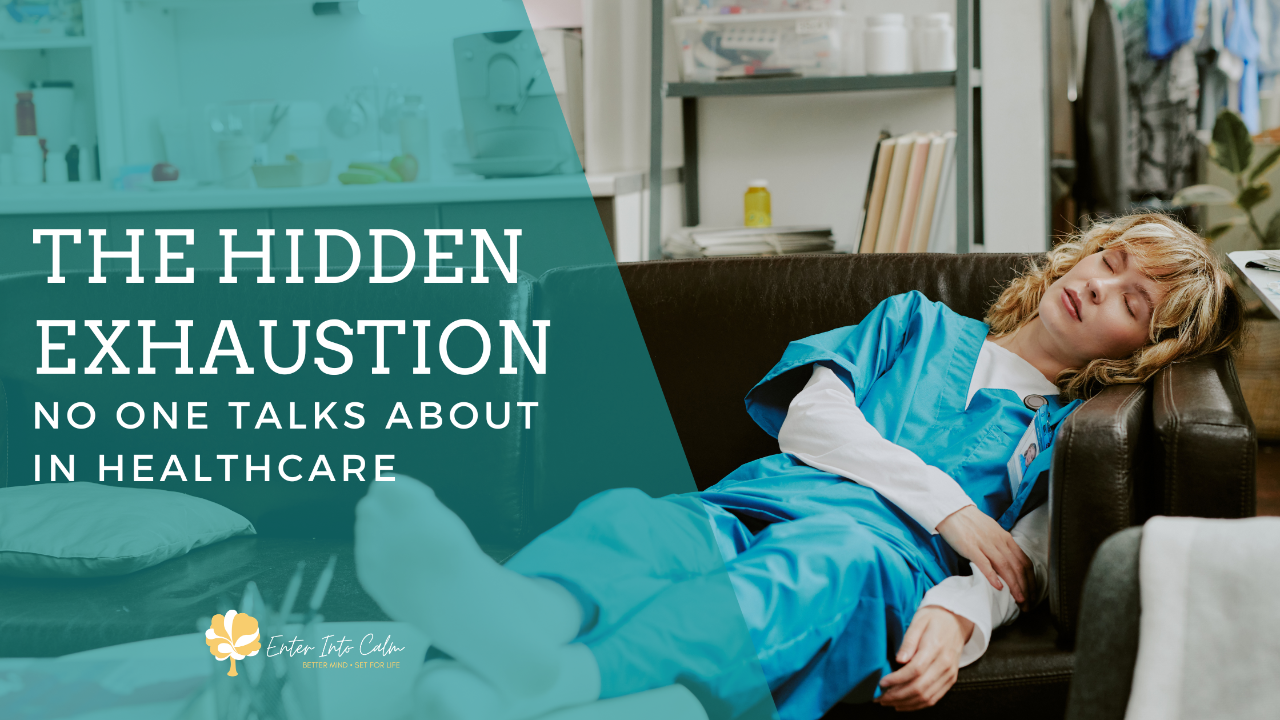
Decision Fatigue in the Nervous System
You’re making decisions all day.
Clinical decisions.
Emotional decisions.
Micro-decisions no one sees.
Who needs you first.
What matters most.
How to respond… even when you’re running on empty.
And by the end of the day?
You don’t want to decide anything.
Not what to eat.
Not what to say.
Not even what you need.
That’s not laziness.
That’s not lack of discipline.
That’s something deeper:
Your nervous system is fatigued.

And for many, this doesn’t start with decisions—it starts with a system that’s been running in the background for too long without a true reset.
👉 Running in the background for too long
What Decision Fatigue Really Is
We often think of decision fatigue as mental.
Too many choices.
Too much thinking.
And in healthcare, it goes far beyond that.
Every decision carries:
- Responsibility
- Emotional weight
- Potential consequences
Which means your body is not just thinking…
It’s responding physiologically.
Chronic exposure to high-demand decision-making environments has been linked to sustained stress activation, impacting both psychological and physiological systems (Hirten et al., 2021).
Your nervous system is constantly asking:
“Am I safe?”
“Am I responsible?”
“Do I have enough to handle this?”
And when the answer is always “keep going”…
It never gets to reset.
The Loop Most People Don’t See
Here’s where it becomes a cycle:
- High demand → constant decision-making
- Nervous system activation → stress response
- Reduced recovery → decreased capacity
- Lower capacity → decisions feel harder
- Harder decisions → more stress
And the loop continues.
This is often where people begin to recognize that it’s not just about doing more or trying harder—it’s about understanding the pattern underneath what’s happening.
Research shows that chronic stress contributes to autonomic dysregulation and reduced resilience, especially in healthcare workers (Kanthak et al., 2017).
Meaning:
You’re not just tired.
Your system has less capacity to handle what used to feel manageable.
How It Shows Up Day to Day
This kind of exhaustion is often invisible.
You may notice:
- Simple decisions feel overwhelming
- You second-guess yourself more
- You feel mentally foggy
- You avoid decisions when you can
- You feel emotionally flat… or easily overwhelmed
And at the same time…
You’re still showing up.
Still functioning.
Which makes it even harder to recognize.
Why Rest Alone Doesn’t Fix It

You might think:
“I just need time off.”
And rest is important.
And if your nervous system is still in a state of activation…
Rest doesn’t fully land.
Because your body hasn’t shifted states.
For many healthcare professionals, this becomes the missing piece—learning how to shift out of constant activation and into a state the body recognizes as safe:
Studies show that healthcare workers under chronic stress often demonstrate impaired recovery—even during non-working periods (Borchini et al., 2018).
So even when you’re off…
Your system is still “on.”
This Is Where the Mind-Body Connection Matters
Your thoughts, your emotions, and your physiology are not separate systems.
They’re one loop.
The American Heart Association highlights the direct connection between psychological stress and cardiovascular and nervous system function (Levine et al., 2021).
So when your nervous system is dysregulated:
- Thinking becomes harder
- Emotional regulation becomes harder
- Decision-making becomes harder
Not because you’re failing…
Because your system is overloaded.
There’s a Missing Piece in Most Burnout Conversations
Most solutions focus on:
Time management
Cognitive strategies
External changes
And those matter.
And they don’t address the full picture.
Because decision fatigue is not just cognitive.
It’s physiological depletion.
Which means the pathway forward includes:
- Restoring nervous system balance
- Increasing internal capacity
- Reconnecting to the body
And something that might feel unexpected…
Reintroducing play.
Why Play Matters More Than You Think
Play isn’t extra.
It’s not a reward.
It’s part of how your system restores itself.
Research exploring helping professionals shows that body-based play can evoke a sense of freedom and joy that supports the restoration of empathy and emotional capacity (Cárdenas, 2022).
Even simple forms of movement-based play—like hoop dancing—have been shown to support stress reduction, emotional release, and improved well-being in nurses experiencing burnout and compassion fatigue (Sánchez et al., 2014).
And for many, this starts with something surprisingly simple.
A hoop.
Not a metaphor at first.
An actual hoop.
The kind you might remember from childhood.
Inside the Rooted HEART Intensives, one of the experiences participants step into is creating and working with their own hoop.
At first, it can feel almost… too simple.
And then something shifts.
Because the hoop becomes more than an object.
It becomes:
- a boundary
- a space
- a place to return to
A place where your attention comes back to the present moment.
A place where your body begins to settle.
A place where you can begin to experience yourself… differently.
Over time, that experience deepens.
The hoop becomes an anchor.
Not just for movement—but for awareness.
The Deeper Meaning of the Hoop
There’s a reason this experience resonates so deeply.
In many traditions, the hoop carries symbolic meaning.
In The Four-Fold Way, Angeles Arrien describes how some Native cultures use the term “sacred hoop” to represent authenticity—being connected to who you truly are.
She writes that when we remember who we are, we bring our authentic self forward.
And many of us learned, early on, to move away from that—
to adapt, to perform, to survive.
At some point, that adaptation becomes a habit.
And the body holds it.
So even when it’s no longer needed…
it’s still running.
The idea of the sacred hoop offers something simple and powerful:
When you are fully yourself…
you are inside your hoop.
When you feel grounded, connected, and present…
you are inside your hoop.
When you come home to yourself…
you are sitting inside your hoop.
Why This Matters for Decision Fatigue
Because decision fatigue isn’t just about thinking.
It’s about disconnection.
From:
- your body
- your internal signals
- your sense of clarity
When you’re constantly outside your “hoop”—
responding, reacting, performing—
Your system works harder to make every decision.
Everything takes more energy.
And when you begin to reconnect—even briefly—
Something shifts.
Not because you forced it.
And because your system recognizes something familiar:
Safety. Presence. You.
This Is the Work
Inside the Rooted HEART Intensives, this becomes a thread.
Not as performance.
Not as something you have to get right.
And as a series of experiences that help you:
- reconnect with your body
- explore your internal patterns
- and begin to restore your natural capacity
Gently.
Because every day, in every way…
You can begin to come back to yourself.
And it’s up to you when you’re ready to step into that.
Moving Forward
If you’re recognizing yourself in this, it makes sense.
You’ve been holding a lot… for a long time.
And your system has adapted the only way it knows how.
The shift doesn’t come from forcing yourself to think more clearly…
It begins by creating the conditions where clarity can return.
Where your body starts to settle.
Where decisions don’t feel as heavy.
Where you can hear yourself again.
This is the kind of work we explore inside Calm Collective Care.
Some people begin with small shifts—guided experiences, group work, learning how to reconnect with their own internal signals.
And others reach a point where they’re ready to step away from the constant demands…
and give themselves space to reset more fully.
If you’re curious what that could look like, you can start here:
Or explore what a more immersive reset can offer:
→ https://www.enterintocalm.com/rootedheart
You don’t have to decide anything right now.
You can simply notice what resonates…
And take the next step when it feels right.
It’s always up to you.
Guest Author:
Christy is dedicated to helping clients overcome anxiety, depression, and phobias by using evidence-based hypnosis and NLP techniques. With a focus on addressing the root causes of mental health challenges, she provides tailored strategies that promote emotional resilience and lasting well-being. Drawing on her extensive background in anesthesiology and psychiatric mental health, Christy creates a safe, supportive environment where clients can achieve mental clarity, boost their confidence, and break free from limiting fears.
References:
- Arrien, A. (1993). The four-fold way: Walking the paths of the warrior, teacher, healer, and visionary. HarperOne.
- Borchini, R., Veronesi, G., Bonzini, M., et al. (2018).Heart rate variability frequency domain alterations among healthy nurses exposed to prolonged work stress. International Journal of Environmental Research and Public Health, 15(6), 1130. https://doi.org/10.2486/indhealth.2017-0190
- Hirten, R. P., Danieletto, M., Tomalin, L., et al. (2021). Factors associated with longitudinal psychological and physiological stress in health care workers during the COVID-19 pandemic: Observational study using Apple Watch data. Journal of Medical Internet Research, 23(10), e31295. https://doi.org/10.2196/31295
- Kanthak, M. K., Stalder, T., Hill, L. K., Thayer, J. F., Penz, M., & Kirschbaum, C. (2017). Autonomic dysregulation in burnout and depression: Evidence for the central role of exhaustion. Scandinavian Journal of Work, Environment & Health, 43(2), 119–128. https://doi.org/10.5271/sjweh.3647
- Levine, G. N., Cohen, B. E., Commodore-Mensah, Y., et al. (2021).
Psychological health, well-being, and the mind-heart-body connection: A scientific statement from the American Heart Association. Circulation, 143(10), e763–e783. https://doi.org/10.1161/CIR.0000000000000947 - Cárdenas, C. P. (2022). The significance of play in restoring compassion (Doctoral dissertation, Meridian University).
- Sánchez, C., Valdez, A., & Johnson, L. (2014). Hoop dancing to prevent and decrease burnout and compassion fatigue. Journal of Emergency Nursing, 40(4), 394–395. https://doi.org/10.1016/j.jen.2014.04.013
Be Calm ...
and experience hypnosis!
Hypnosis can help in many ways. Curious Minds should Stay Curious.
Boost Self-confidence • Lessen Anxiety • Grief• Cancer • Create Positive Mindset • Eliminate Limiting Beliefs • Improve Sleep • Manage Pain Better • Prepare for Childbirth • Enhance Performance • Heal & Resolve Grief • Change Habits • Weight Loss without Dieting • Smoking Cessation • Stress Reduction • Stop Teeth Grinding • & more
Connecting with me 1:1 is fast and easy!
